Food and Supplements

Yum!!What goes in comes out as the saying goes. That's why we do our best to put the highest quality food we can into our dogs.
Believe it or not, the better food you feed your dogs the less they poop! That is because they are able to utilize more ingredients and nutrients, therefore, having less waste.
We thought about feeding expensive dog food such as Blue Buffalo, Taste of the Wild, or Orijen. Then, as we investigated dry dog food ingredients, we found even some of these expensive brands were not quality food. After much research, and talking with other breeders, we have found a dry food that is healthy and reasonably priced. The food that we have used for years with great results is Diamond Naturals Chicken and Rice. This is available at most pet stores and is highly popular. We do not feed a grain free diet because there has been some new research by the FDA corresponding grain free diets to canine dilated cardiomyopathy (DCM). This is a heart disease that affects the heart muscle and can lead to congestive heart failure. If you would like to learn more about this new research, take a look at this AKC article on the topic.
Along the supplements line, we feed both fish oil and joint aid. Fish oil we feed daily for the entire life of our dog. This promotes healthy skin and gives that glossy sheen to their coats. We feed Kirkland's Signature Fish Oil once a day.
Most people will feed joint aid to their dog as they age and begin to suffer from arthritis and joint pain. Our theory is to feed joint aid as their joints are growing, and in so doing, reinforce healthy joints that will carry them pain free for the majority of their life. We feed Joint Aid 4 Dogs until they are two years old and would highly recommend you do the same if you have a puppy.
When we're in the mood to spoil our pups, we will give them an antler chew, Kong, or venison leg bone. We also will get the cheap knuckle bones from the meat department at the grocery store occasionally.
DO NOT EVER feed your dog a rawhide chew of any kind! The process of making rawhide is very toxic to begin with. On top of that, a dog cannot properly digest rawhide pieces. Because of this, these pieces then can become stuck in your dog's digestive system causing a potentially fatal blockage. Despite all the advertisements, rawhide chews are VERY dangerous and should never be given to a dog, especially a Labrador!
Service Dog or Family Dog?
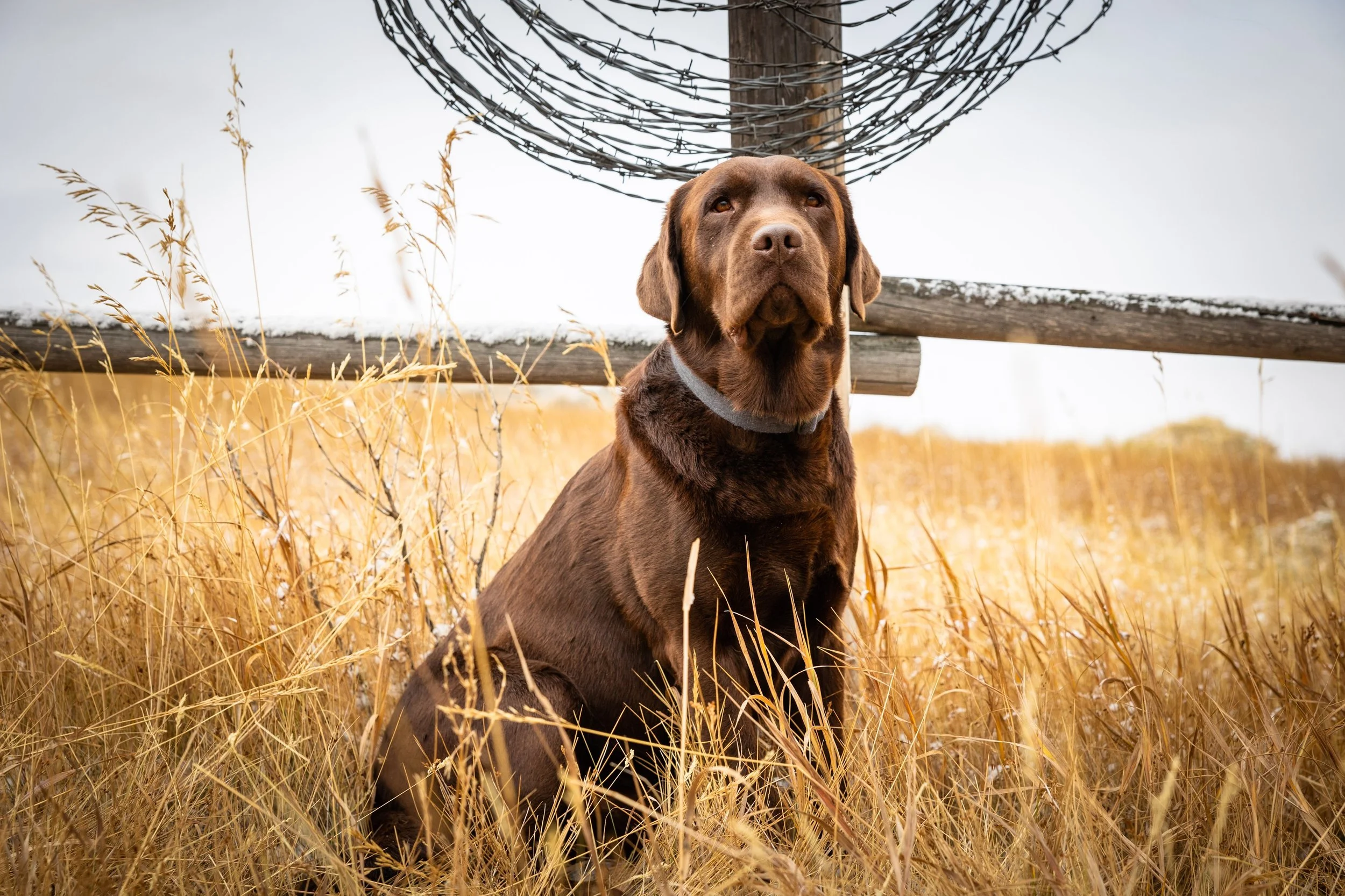
"How do you decide if a pup is going to be a service dog or a companion dog?" This is a question we frequently receive from potential clients who are considering purchasing a dog from us. While all the dogs that we produce are incredible creatures, not every dog is perfect for the working life. The standards are so high for service dogs going through our program that we carefully identify pups with temperaments conducive to service dog training, detector dog training or those better suited to in a family dog life.
At seven weeks of age, we do what is called PAT testing, (Puppy Aptitude Test). We use a combination of the Volhard test and our own tests to determine if a pup has service potential or not. In addition to the Volhard test, we have added a couple problem solving and curiosity evaluations. Two of which are sound and smell tests. All of the tests are done in a room that the pup has never before been in, and the evaluator is a person the pup has never met. This helps to give a truer evaluation of who the pup is, and what his/her potential could be.
The Volhard test is a combination of tests that evaluate many different aspects of the puppy. Rated on a scale of one to six, they are tested on social attraction, social dominance, retrieving, as well as other things. Here is a video of one of our pups going through the Volhard section of the PAT test
The expectation for a cuddle buddy is not nearly as intense as it is for a service animal. Since they don't have to be constantly working, and they don't need to have an incredible sense of smell, picking companion dogs is a much easier process. When we have puppies that have shown that they would better fit as a family dog, we will then look for a family, couple, or individual that best suits that particular puppy. Some pups have lots of energy and exuberance! Others are snuggle bugs and love to relax. We do our best to place pups with a family that matches their personality. Energy and wiggles thrives best in a busy family with active kids. The more relaxed calm puppy may do better with an elderly couple.
Sometimes we will have a puppy come through our program that is a bit higher drive than our average service dog. In those instances, we will do our best to place those pups in drug or explosive detection work. Detection dogs need to have an incredible sense of smell, while oozing confidence. Some of our pups we have placed in this line of work and they have excelled at their job.
As you can see, there is much forethought, time, and energy expended as we do our best to place our Dutydog puppies and dogs in their ideal home.
Training materials
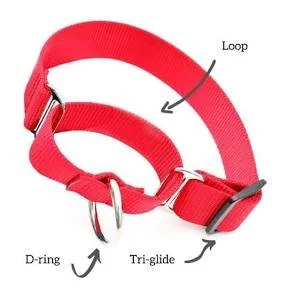
We utilize only a martingale collar for all of our leash training. It slips over their head and is loose on their neck until you need to correct the dog. Then a tug on the collar tightens the collar to get their attention. When you release tension the nylon material gives instantly verses a chain slip collar can catch on the chain links and not give the quick release.
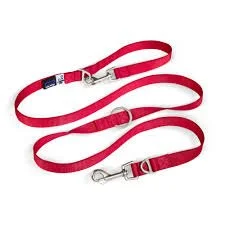
We love using a 3 way adjustable leash for training, especially for service dog training. It gives so many different options for different training situations.
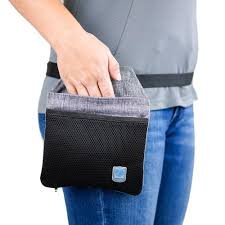
Because of the amount of training we do, we use only dog kibble for our training. If we used dog treats, we would have some chunky labradors… When we are doing intensive training with puppies and service dogs they get all their food from training sessions. We like to use a training pouch on our belt so that our pockets don’t get all oily from the kibble.